Reunification Therapy in New Jersey:
How It Works and When Your Family Needs It
When a child refuses to see one parent, it breaks something in a family that feels impossible to fix. The silence is heavy. The distance grows. And everyone — especially the child — pays the price.
If this is your reality right now, you're not alone.
Reunification therapy in New Jersey helps families rebuild what's been broken. It's a structured, specialized form of therapy designed for parents and children who've grown apart — whether through divorce, estrangement, parental alienation, or a long absence.
It's not a quick fix. But with the right therapist, real healing is possible.
This guide covers everything you need to know about reunification therapy in New Jersey — what it is, how it works, when to seek it, and how to find the right therapist for your family.

What Is Reunification Therapy?
Reunification therapy is a structured therapeutic process with one specific goal: repairing the relationship between a child and a parent after a significant breakdown.
Think about this scenario. A father hasn't seen his ten-year-old daughter in over a year after a bitter divorce. His daughter won't take his calls. She tells her mother she never wants to see him again. He's devastated. She's hurting. And no one knows how to bridge the gap without making things worse.
That's exactly the kind of situation reunification therapy in New Jersey is designed for.
It's used when a parent-child relationship has been damaged by divorce, high-conflict custody disputes, parental alienation, extended absence, or estrangement. Unlike general counseling, reunification therapy follows a clear, structured plan. Progress is tracked carefully. And the therapist often works directly with attorneys, guardian ad litems, and New Jersey family court judges to make sure the child's safety and wellbeing come first.
The goal isn't to force a relationship. It's to create the safe, gradual conditions where connection can grow again — on the child's terms.
Reunification Therapy vs. Family Therapy: What's the Difference?!
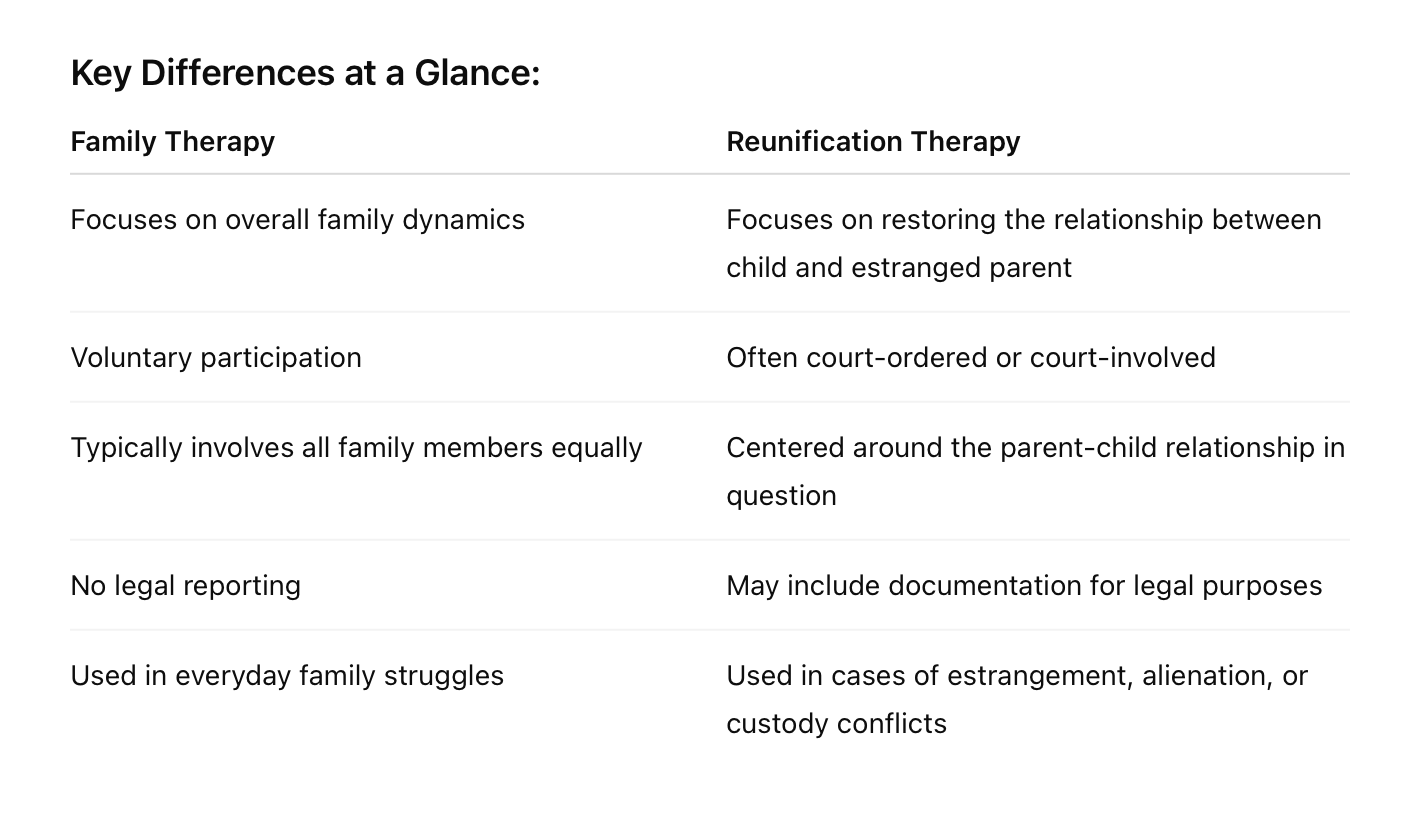
A lot of parents ask this question, and it's a good one. The two are related — but they're not the same thing, and choosing the wrong type of therapy can actually slow things down.
What Is Family Therapy?
Family therapy helps families communicate better, resolve conflict, and strengthen their relationships overall. It works well when all family members are reasonably open to participating and the goal is improving day-to-day family dynamics. It's a great fit when there's no significant legal dispute involved and no parent-child relationship has fully collapsed.
Family therapy in New Jersey draws on approaches like Cognitive Behavioral Therapy (CBT), attachment-based therapy, and structural family therapy. It helps a lot of families. But it's not built for situations where a child has completely rejected a parent or contact has stopped altogether. Trying to use traditional family therapy in those cases is a bit like using a bandage when you actually need surgery.
What Makes Reunification Therapy Different?
Reunification therapy in New Jersey is designed for high-stakes, high-conflict situations — the ones where regular counseling simply isn't enough. It's the right fit when a child refuses all contact with one parent, when parental alienation is suspected or confirmed, or when a family court judge has ordered therapy as part of a custody arrangement.
It's also appropriate when estrangement stems from something deeper — a parent's past struggle with addiction, a mental health crisis, or years of absence that left a child feeling abandoned. The process is more structured and more intensive than standard family therapy. It involves individual sessions with the child, individual sessions with each parent, and carefully timed joint sessions when the child is ready. It often includes coordination with the legal system. And it requires a therapist with specialized training in high-conflict family dynamics — not just a general counseling background.
Signs Your Family Might Need Reunification Therapy in New Jersey
It can be hard to know when regular counseling isn't enough anymore. Here's what often pushes families toward reunification therapy in NJ.
Your child refuses to visit or have any contact with one parent. Your child expresses fear, anger, or intense dislike toward one parent that seems extreme or out of proportion to what's actually happened. You're in the middle of a high-conflict divorce or custody dispute that's dragging on. A family court judge or guardian ad litem has specifically recommended reunification therapy in New Jersey. There's been a long gap — months or even years — with little or no parent-child contact. Or a parent has come back after an extended absence and genuinely wants to rebuild the relationship but doesn't know how.
If several of these fit your situation, it's time to reach out to a reunification therapist in NJ. The longer estrangement goes without intervention, the harder the road back tends to be.
How Reunification Therapy in New Jersey Works
Every family's story is different. But reunification therapy in New Jersey typically follows four phases, each designed to protect the child while creating space for real healing.
Phase One: Assessment
Everything starts with a thorough assessment. The reunification therapist meets individually with the child and with each parent. This isn't just a formality — it's where the therapist figures out why the estrangement happened, what the child is actually feeling, and whether contact is even safe to introduce yet.
This phase is non-negotiable. Rushing into joint sessions without it often makes things worse. Picture a therapist sitting across from an eight-year-old who says she's scared of her dad. Before anything else happens, the therapist needs to understand whether that fear is based on real danger, on things she's heard from one parent, or on her own confusion about everything that's changed in her world. The assessment answers those questions.
Phase Two: Individual Work
Before the child and parent come together, each person does their own therapeutic work separately. The child gets a safe space to explore their feelings, process any trauma, and build the emotional tools they'll need when reunification begins. The parent, meanwhile, works on understanding their role in the breakdown. They develop genuine empathy for the child's experience and — this part is important — they learn how to show up differently this time.
This phase takes patience. A lot of parents want to skip ahead to seeing their child. That's completely understandable. But the individual work is what makes the joint sessions actually stick.
Phase Three: Gradual Reunification
When the therapist determines the child is ready, joint sessions begin — slowly and carefully. Early sessions are short and structured. The therapist guides every interaction. There's no pressure for the relationship to feel warm right away, because forced warmth isn't real warmth.
Over time, as trust rebuilds, sessions grow longer and feel more natural. The end goal is a parent-child relationship that can keep growing on its own — one that doesn't depend on a therapist in the room to hold it together.
Phase Four: Transition and Ongoing Support
As reunification therapy progresses, the therapist helps the family settle into a new normal. This includes parenting support, co-parenting guidance, and practical strategies for sustaining the relationship outside of sessions. For court-ordered cases, this phase often includes formal reporting back to the New Jersey family court on the family's progress.
Court-Ordered Reunification Therapy in NJ: What to Expect
New Jersey family courts don't take parent-child estrangement lightly. When a child is refusing contact — or when parental alienation is alleged — judges frequently order reunification therapy as part of the custody resolution.

Court-ordered reunification therapy in NJ comes with specific requirements that families should understand going in. The therapist will likely need to provide written progress reports directly to the court. Both parents are required to participate — even if one of them disagrees with the recommendation or flat-out resents being there. The therapist must remain completely neutral, focused only on the child's wellbeing rather than advocating for either parent. And refusing to comply isn't just bad for the therapeutic process — it can have real legal consequences.
Court-ordered reunification therapy in NJ comes with specific requirements that families should understand going in. The therapist will likely need to provide written progress reports directly to the court. Both parents are required to participate — even if one of them disagrees with the recommendation or flat-out resents being there. The therapist must remain completely neutral, focused only on the child's wellbeing rather than advocating for either parent. And refusing to comply isn't just bad for the therapeutic process — it can have real legal consequences.
If your case involves a court order, it's critical to work with a reunification therapist in New Jersey who's experienced in the legal system. They'll know how to document progress properly, communicate effectively with attorneys, and meet the court's expectations — all while keeping the therapeutic process intact and child-centered.
What to Look for in a Reunification Therapist in NJ
Not every therapist is trained for this work. Reunification therapy sits at a complicated intersection of family dynamics, child development, trauma, and family law. Choosing the wrong therapist — even a well-meaning one — can stall progress or, in some cases, make an already fragile situation more volatile.
Here's what you're looking for. First, specialized training. Your therapist should have direct, hands-on experience with reunification therapy, parental alienation, and high-conflict divorce — not just a general background in family counseling. Second, if your case involves legal proceedings, your therapist needs to be genuinely comfortable working alongside attorneys and the New Jersey family court system, not just tolerating it. And third — and this one matters enormously — they need to be truly neutral. A skilled reunification therapist doesn't take sides, doesn't get pulled into one parent's narrative, and keeps the child at the absolute center of every decision.
Questions to Ask Before You Commit
Most therapists offer an initial consultation, and you should absolutely use it. Ask them about their specific experience with reunification therapy in New Jersey. Ask how they approach cases involving parental alienation, and whether they've worked with court-ordered situations before. Ask what a realistic timeline looks like for a family like yours, and what they do when one parent isn't cooperating. The right reunification therapist in NJ won't hesitate to answer any of these — they'll welcome the questions.
How Long Does Reunification Therapy Take?
There's no single answer to this, and any therapist who gives you a precise timeline at the first consultation should raise a flag.
The truth is, the timeline for reunification therapy in New Jersey depends on so many things. How long has the estrangement been going on? How old is the child, and how emotionally ready are they? Are both parents genuinely committed to the process, or is one of them just going through the motions to satisfy the court? Are there safety concerns that need to be resolved before contact can happen at all?
Some families start seeing real progress within a few months. Others need a year or more of consistent, steady work. What matters most isn't speed — it's whether the relationship being rebuilt is strong enough to actually last. Rushing to meet a court deadline or satisfy a parent's urgency almost always backfires. A good reunification therapist in NJ follows the child's lead, not the calendar.
How Reunification Therapy Helps the Whole Family
Reunification therapy in New Jersey doesn't just help the estranged parent and child. It shifts something in the entire family.
Ongoing co-parenting conflict is one of the most damaging things children can grow up in. When parents use their kids as messengers, undermine each other constantly, or turn every custody exchange into a battle — children absorb all of it. They carry that weight long after the divorce is finalized and the court orders are signed.
Reunification therapy creates a structured, neutral space where those patterns can finally be interrupted. Parents learn — sometimes for the first time — how to genuinely put their child first. Children learn that they don't have to choose sides. And slowly, the whole family starts to function in a way that gives everyone, especially the kids, room to actually heal.
Frequently Asked Questions About Reunification Therapy in New Jersey
What's the difference between reunification therapy and co-parenting counseling?
Co-parenting counseling helps two parents work together more effectively as a team. Reunification therapy in New Jersey specifically focuses on repairing the bond between a child and a parent. They're different services — though plenty of families find that they benefit from both at different stages.
Can a child be required to attend reunification therapy?
In court-ordered cases, yes. That said, a skilled reunification therapist will work carefully to make sure the child feels safe and respected throughout the process — even when attendance isn't optional. A good therapist doesn't drag a child through sessions. They meet the child where they are and build trust first.
Does reunification therapy always work?
Not in every case, and it's important to be honest about that. Success depends heavily on both parents' genuine commitment, the child's age and emotional resilience, and how long the estrangement has been going on. But when everyone is truly engaged in the process, reunification therapy in New Jersey produces meaningful, lasting results for many families.
What if one parent won't participate?
This is one of the most common challenges in reunification cases. If participation is court-ordered and a parent refuses, that non-compliance is typically reported directly to the court. If it's voluntary, the therapist may begin working with the willing parent and child first — and address the other parent's involvement as therapy progresses.
Is reunification therapy covered by insurance?
No— Unfortunately, reunification therapy is not covered by insurance. Insurance companies require a mental health diagnosis for billing purposes, and reunification therapy doesn't fit that model — it's a court-mandated, legally driven process rather than a clinical mental health treatment. Because it falls outside the scope of what insurance considers a medical necessity, families should plan to pay out of pocket.
How do I find a reunification therapist near me in New Jersey?
Your best starting points are your family court, your attorney, or your child's pediatrician — they often know who in the area specializes in this work. CONTACT US HERE to see if we would be a good fit for your family.
Taking the First Step Toward Reunification Therapy in New Jersey
The breakdown of a parent-child relationship is one of the most painful things a family can go through. It can feel permanent. Like too much time has passed. Like too much has been said. But it doesn't have to stay that way.
Reunification therapy in New Jersey offers a real, structured path back to connection. It takes honesty. It takes patience. It takes a genuine willingness to put the child first — even when that's uncomfortable. But for families who commit to that work, the results can be genuinely life-changing.
At Hanisch Counseling Services, we specialize in reunification therapy for New Jersey families working through divorce, estrangement, and high-conflict custody situations. Our therapists bring specialized training, true neutrality, and deep care for every family we work with — because we know how much is at stake.
Whether you're a parent hoping to reconnect, a co-parent trying to find a path forward, or a legal professional looking for a trusted NJ reunification therapist — we're here, and we're ready to help.
Schedule a consultation today and take the first step toward reconnecting.