When Anxiety Makes Everything Feel True
If you've ever watched your teenager spiral before a test, shut down before a social event, or convince themselves that something terrible is about to happen — you've witnessed anxiety in teens up close. And one of the most confusing parts for parents is this: your teen isn't being dramatic. They genuinely believe what their anxious mind is telling them.
That's the nature of teen anxiety. It doesn't just create fear — it creates certainty. When anxiety is running the show, the thought "everyone is going to laugh at me" doesn't feel like a possibility. It feels like a fact. And no amount of "You're going to be fine!" seems to reach them in those moments.
The good news is that there's a deceptively simple tool that can help your teen begin to separate what they feel from what is actually true — and you can introduce it at home! It's called the Feelings Side vs. Logical Side exercise, and I'm going to walk you through exactly how it works.
Imagine your teen sitting at the kitchen table the night before a test. They've studied for hours, yet they're convinced they're going to fail. You remind them of their preparation, but nothing seems to help. In moments like these, anxiety isn't just creating worry — it's convincing them that the worst-case scenario is already true!
Why Anxiety in Teens Makes Thoughts Feel Like Facts
Before we get to the exercise, it helps to understand what's happening in your teen's brain when anxiety spikes. Understanding anxiety in teens begins with recognizing that anxious thoughts often feel completely true in the moment.
Think of the brain as having two main systems working at the same time… One is fast, reactive, and emotional — it's the part of the brain that sounds the alarm when something feels threatening. The other is slower, more thoughtful, and logical — it helps us weigh options, consider evidence, and think things through.
When your teen is anxious, that fast, emotional system essentially takes over. It floods the brain with stress signals that make the perceived threat feel real and immediate. In that state, the logical part of the brain gets drowned out. It's not that your teen can't think logically — it's that anxiety is biologically designed to make logical thinking harder to access.
This is why telling an anxious teen to "just calm down" or "think rationally" rarely works. They're not being stubborn or irrational on purpose. Their nervous system has temporarily taken the wheel, and their thoughts feel 100% accurate — even when they aren't.
Understanding this changes everything about how we approach how to help a teenager with anxiety. Instead of arguing with the thought or trying to eliminate the feeling, we help them learn to hold both — the feeling and the logic — at the same time.

The "Feelings Side vs. Logical Side" Exercise
This exercise is simple enough to do on a napkin and effective enough to shift how your teen relates to anxious thoughts. It's a great starting point in anxiety therapy for teens, and it's equally effective as a coping skill for anxiety that parents can introduce at home!
How to Do It
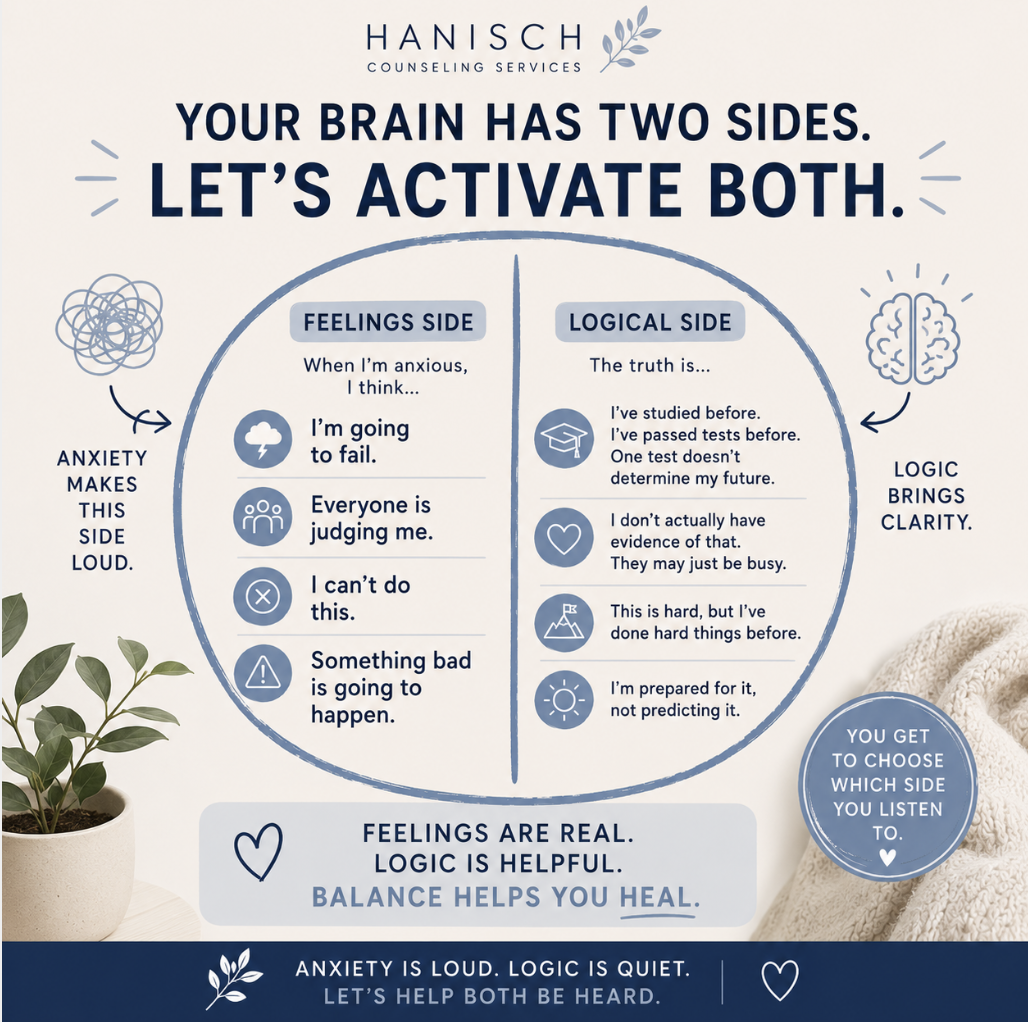
Have your teen grab a piece of paper and draw a circle — or you can draw it together. Divide the circle down the middle into two halves.
Label the left half: Feelings Side
Label the right half: Logical Side
That's it. Now here's the key instruction:
"On the Feelings Side, write down everything your anxiety is telling you. Don't filter it — just let it out. On the Logical Side, write down what the evidence actually says."
The goal isn't to dismiss the feelings or "win" with logic. The goal is to give both sides equal space on the page — because both are real, and both deserve to be heard. Anxiety shrinks when it's no longer the only voice in the room.
Real-Life Examples for Anxious Teens
Let's look at how this plays out across some of the most common situations that trigger teen anxiety.
Test Anxiety
Feelings Side says: "I'm going to fail this test. I studied but I still don't know anything. Everyone else is smarter than me. My future is ruined if I don't do well."
Logical Side says: "I did study. I've passed tests before. One grade doesn't define my future. I can ask for help if I'm struggling. Feeling unprepared isn't the same as being unprepared."
Social Anxiety
Feelings Side says: "If I say something weird at the party, everyone will talk about me. I'll humiliate myself. Nobody actually wants me there. It's safer to just stay home."
Logical Side says: "Most people are focused on themselves, not on me. I've had awkward moments before and survived them. The people who invited me wanted me to come. Avoiding it usually makes my anxiety worse, not better."
Sports or Performance Anxiety
Feelings Side says: "I'm going to mess up in front of everyone. My coach is going to be so disappointed. I'll let the whole team down. I always choke under pressure."
Logical Side says: "I've performed well in practice. Everyone makes mistakes — even the best athletes. My coach knows I work hard. One mistake doesn't erase all my effort."
Going Away to College
Feelings Side says: "I won't make any friends. I'll be completely alone. I can't handle being away from home. What if something goes wrong and I'm not okay?"
Logical Side says: "Lots of people feel nervous going to college — it's a big transition. I've navigated hard things before. I can call home whenever I need to. It may take time, but most people do find their people." (check out our college therapy intensive promo being offered!)
Fear of Making Mistakes
Feelings Side says: "If I make a mistake, it means I'm a failure. People will think less of me. I should only try things I know I can do perfectly."
Logical Side says: "Mistakes are how people learn. Everyone makes them — even people I admire. Making a mistake doesn't make me a bad person. Avoiding everything because I might fail is keeping me stuck."
How Parents Can Use This Tool at Home
One reason this exercise works so well for anxiety in teens is that it teaches young people to slow down and evaluate their thoughts without judging themselves. The most important thing to know about introducing this exercise is this: your job is to be curious, not corrective.
When your teen fills out the Feelings Side, resist the urge to jump in with "But that's not true!" or "You're catastrophizing." Even if they are catastrophizing — and they probably are — that response shuts the conversation down. The feelings are real to them, and they need to feel heard before they can access logic.

Here's some language that tends to work well:
"Tell me more about what the Feelings Side is saying."
"That makes sense that you'd feel that way — anxiety is really loud sometimes."
"What do you think the Logical Side might say, if you gave it a chance?"
"You don't have to believe the logical side right now — just write it down."
Notice that last one. You're not asking your teen to stop feeling anxious. You're not asking them to agree that the logical side is right. You're simply helping them practice holding two different perspectives at once — which is a skill that gets stronger over time.
Also worth knowing: some teens may resist the exercise at first, especially if their anxiety is intense. That's okay! Even naming "we have a feelings side and a logical side" can plant a seed that helps later.
Common Mistakes Parents Make When Helping an Anxious Teen
Parents often assume that anxiety in teens can be resolved through reassurance alone, but long-term growth comes from building coping skills and confidence. Even the most loving, well-intentioned parents can accidentally make anxiety worse. Here are a few patterns worth watching for:
Arguing with the anxious thought. When you say "That's ridiculous — you're going to be fine," your teen hears "Your feelings are wrong." Anxiety digs in deeper when it feels dismissed.
Offering too much reassurance. It feels kind to say "I promise nothing bad will happen" — but excessive reassurance actually reinforces the idea that there's something to be afraid of. It also doesn't help your teen build confidence in their own ability to cope.
Trying to fix the anxiety immediately. Anxiety isn't a problem to be solved in one conversation. The goal isn't to eliminate the feeling — it's to help your teen develop a relationship with their feelings that isn't ruled by fear. That takes time, practice, and patience.
When Anxiety in Teens May Need Professional Support
While occasional worry is normal, persistent anxiety in teens can affect school performance, friendships, sleep, and family relationships. This exercise is a wonderful starting point, but it isn't a replacement for professional care. If your teen's anxiety is significantly affecting their sleep, friendships, school performance, or ability to do things they used to enjoy, it may be time to connect with an anxiety therapist who specializes in teen mental health.
Some signs that anxiety treatment for teens may be needed:
Persistent avoidance of school, social situations, or activities
Physical symptoms like stomachaches, headaches, or trouble sleeping that have no medical cause
Panic attacks or intense episodes of fear that are hard to recover from
Withdrawal from friends and family
Increasing dependence on a parent to get through ordinary situations
Anxiety therapy for teens often includes evidence-based approaches like Cognitive Behavioral Therapy (CBT), which directly targets the thoughts-feelings connection, and EMDR therapy (Eye Movement Desensitization and Reprocessing), which can be especially helpful when anxiety is rooted in past experiences or trauma. A skilled anxiety therapist can work with your teen to build lasting coping skills for anxiety that go far deeper than any single exercise.
If you're located in New Jersey and are looking for support, reaching out to a therapist who specializes in anxiety treatment for teens is a meaningful next step.
Why Early Support Matters
The earlier anxiety in teens is recognized, the easier it can be to address before patterns of avoidance become deeply ingrained. When teens learn healthy coping skills early, they often experience improvements in confidence, relationships, academic performance, and overall emotional well-being. Parents do not need to wait until anxiety becomes severe before seeking support.
What Progress Can Look Like
A teen who uses this exercise regularly may still feel anxious before a test, social event, or big life transition. The difference is that they begin to recognize anxiety as one voice rather than the only voice. Instead of automatically believing every fearful thought, they learn to pause, consider the evidence, and make decisions based on both feelings and facts. That shift often becomes an important building block for long-term resilience.
Feelings Are Real — But Feelings Aren't Always Facts
Anxiety in teens is one of the most common and treatable mental health challenges young people face. And one of the most powerful things you can teach your teen is this simple truth: feelings are real, but feelings aren't always facts.
The Feelings Side vs. Logical Side exercise gives your teen a concrete way to practice that truth — on paper, where they can actually see it. Over time, that practice builds something anxiety hates: perspective.
Your teen doesn't have to be ruled by their anxious thoughts. They just need tools, support, and a parent who's willing to sit beside them and ask, "What does the logical side say?"
Frequently Asked Questions About Teen Anxiety
1. What does anxiety in teens actually look like? The signs of anxiety in teens can vary depending on personality, age, and stress level. Anxiety in teens can look very different from adult anxiety. You might notice irritability, avoidance of activities, stomachaches before school, excessive worry about grades or friendships, trouble sleeping, or a need for repeated reassurance. Some teens become withdrawn; others may seem angry or oppositional. Because these signs can overlap with typical adolescent behavior, anxiety in teens is often missed or misunderstood.
2. Is it normal for my teenager to be anxious? Some anxiety is completely normal and even healthy — it helps teens prepare for challenges and stay safe. The concern is when anxiety becomes persistent, intense, and starts interfering with daily life. If your teen's anxiety is getting in the way of school, friendships, sleep, or activities they used to enjoy, it's worth exploring further with a professional.
3. What's the difference between normal teen worry and an anxiety disorder? Normal worry tends to be tied to specific situations and fades once the situation resolves. An anxiety disorder involves worry that is more intense, harder to control, longer-lasting, and significantly affects functioning. A qualified anxiety therapist can help determine whether your teen's anxiety rises to the level of a diagnosable condition and recommend appropriate treatment.
4. What types of therapy are most effective for teen anxiety? Cognitive Behavioral Therapy (CBT) is one of the most well-researched approaches for anxiety treatment in teens. It helps teens identify and shift anxious thought patterns, much like the Feelings vs. Logic exercise described above. EMDR therapy is another evidence-based option, particularly helpful for teens whose anxiety is connected to past difficult experiences. A good teen mental health therapist will tailor treatment to your teen's specific needs.
5. How can I help my anxious teen without making the anxiety worse? The most helpful thing you can do is validate your teen's feelings without reinforcing avoidance. That means acknowledging how hard things feel while gently encouraging your teen to engage with — rather than escape from — the things they fear. Practicing tools like the Feelings vs. Logical Side exercise, modeling calm responses to stress, and connecting with an anxiety therapist when needed are all powerful ways to support your teen's mental health journey.
Looking for Anxiety Therapy for Teens in New Jersey?
If your teen is struggling with anxiety, excessive worry, school stress, social anxiety, or avoidance behaviors, professional support can help. At Hanisch Counseling Services, we work with teens and families throughout New Jersey to build practical coping skills for anxiety, strengthen confidence, and reduce anxiety's impact on daily life. Contact us to learn more about anxiety therapy for teens and how we can support your family.

Hanisch Counseling Services specializes in anxiety therapy for children, teens, and adults in New Jersey. Our clinicians are trained in Cognitive Behavioral Therapy (CBT), EMDR, and other evidence-based approaches to help anxious kids build real, lasting coping skills.