Anxiety Activities for Kids: Cloud Thoughts and Rainbow Truths for Managing Worry
Anxiety Activities for Kids | Fairfield, NJ
Cloud Thoughts and Rainbow Truths for Managing Worry
Parents often search for anxiety activities for kids when their child seems stuck in a cycle of worry. Maybe bedtime becomes difficult, Sunday evenings feel overwhelming, or your child constantly asks, "What if something bad happens?"If that sounds familiar, you're not alone. Anxiety is one of the most common challenges children face, and simple, evidence-based anxiety activities for kids can help them build confidence, emotional awareness, and healthier ways to respond to worry.
Maybe it starts with a quiet car ride, a bedtime that stretches too long, or a Sunday night that feels heavier than it should. Your child looks up and says:
"What if I mess up?"
"What if nobody likes me?"
"What if something bad happens?"
You reassure them. You remind them they're loved, they're capable, everything is going to be okay. And for a few minutes, it helps — until the next worry arrives.
One activity you can try is Cloud Thoughts → Rainbow Truths. It's simple enough to do at your kitchen table, powerful enough to build real coping skills, and grounded in the same evidence-based principles we use in anxiety therapy for kids every day.
Here's everything you need to know.
What Are "Cloud Thoughts"?
Every child's brain produces thoughts — hundreds of them, all day long. Most of the time, those thoughts are unremarkable: What's for lunch? I wonder if my friend will be at recess.
But for an anxious child, the brain gets stuck in a different pattern. Instead of moving through thoughts freely, it locks onto danger. It scans for what could go wrong. It rehearses worst-case scenarios until they feel like certainties.
We call these worry thoughts — or Cloud Thoughts.
Cloud Thoughts are the thoughts that show up when anxiety in children takes the wheel:
Nobody is going to want to play with me.
I'm going to fail the test and everyone will know.
What if I say something embarrassing?
Something bad is going to happen to someone I love.
I'm not as good as the other kids.
Cloud Thoughts feel completely real to a child. They're not making them up, and they're not being dramatic. Their brain genuinely believes these thoughts are true — and it's working very hard to protect them from the imagined danger!
The problem is that clouds can grow. One worry thought leads to another, and before long, the whole sky is covered. Your child can't see the sun anymore. They can't remember that they've made friends before, handled hard things before, gotten through hard days before.
here’s an Example
Imagine a child named Mia who feels nervous every morning before school. Her Cloud Thought is:
"Nobody will want to sit with me at lunch."
When Mia pauses and looks for a Rainbow Truth, she remembers:
"I sat with friends three times this week."
The worry doesn't disappear instantly, but it becomes easier to manage because she's looking at the full picture rather than only the fear. This is the skill children practice every time they use Cloud Thoughts and Rainbow Truths.
That's where anxiety activities for kids like this one come in.
Why Children Need Help Challenging Anxiety
Here's one of the most important things to understand about child anxiety: feelings are real, but thoughts are not always facts.
Your child's worry feels completely true to them. But "What if nobody likes me?" is not a statement of fact — it's a prediction. A fear. A story the anxious brain is telling.
This is one of the core ideas behind Cognitive Behavioral Therapy (CBT), one of the most well-researched approaches to treating anxiety in children. CBT helps children learn to notice their thoughts, examine whether those thoughts are accurate, and gradually replace unhelpful thinking patterns with more balanced ones.
The key word is balanced — not positive, not dismissive, not fake.
We're not teaching kids to pretend everything is fine. We're teaching them to look at the whole picture.
When a child learns to say "I've made friends before" in response to "What if nobody likes me?" — that is not toxic positivity. That is a real, true, verifiable fact. And over time, practicing that kind of emotional regulation builds something powerful: the confidence that their own mind can be a safe place, even when anxiety shows up.
Coping skills for anxiety don't develop overnight. But with consistent practice — and your support as a parent — children can and do learn to navigate worry with more ease and resilience.
The Cloud Thoughts → Rainbow Truths Activity
This is one of our favorite anxiety activities for kids and CBT activities for kids because it's hands-on, visual, and doesn't require any special materials or training. You can do it as a craft project, during a quiet afternoon, or as part of your regular routine. It helps children recognize worry patterns while building healthier thinking habits.
What You'll Need
Paper or cardstock (white and several colors)
Popsicle sticks
Markers or crayons
Scissors
Optional: glitter, stickers, anything that makes it feel special to your child
Step 1: Make the Cloud
Cut a large cloud shape out of white or gray paper. This is where your child will write (or you'll write for younger children) their worry thoughts.
Start by asking:
"What are the thoughts that show up when you're feeling worried?"
Write them inside the cloud. Use your child's exact words — don't clean them up. The point is for them to see their own thoughts reflected back.
Examples of what might go in the cloud:
☁️ What if nobody likes me?
☁️ What if I mess up?
☁️ What if something bad happens?
☁️ I'm not good at anything.
☁️ Everyone is going to laugh at me.
There's no wrong answer. Let them fill the cloud completely if they want to. The goal of this step is awareness, not fixing — your child is learning to name their worry thoughts, which is itself a skill.
Step 2: Build the Rainbow
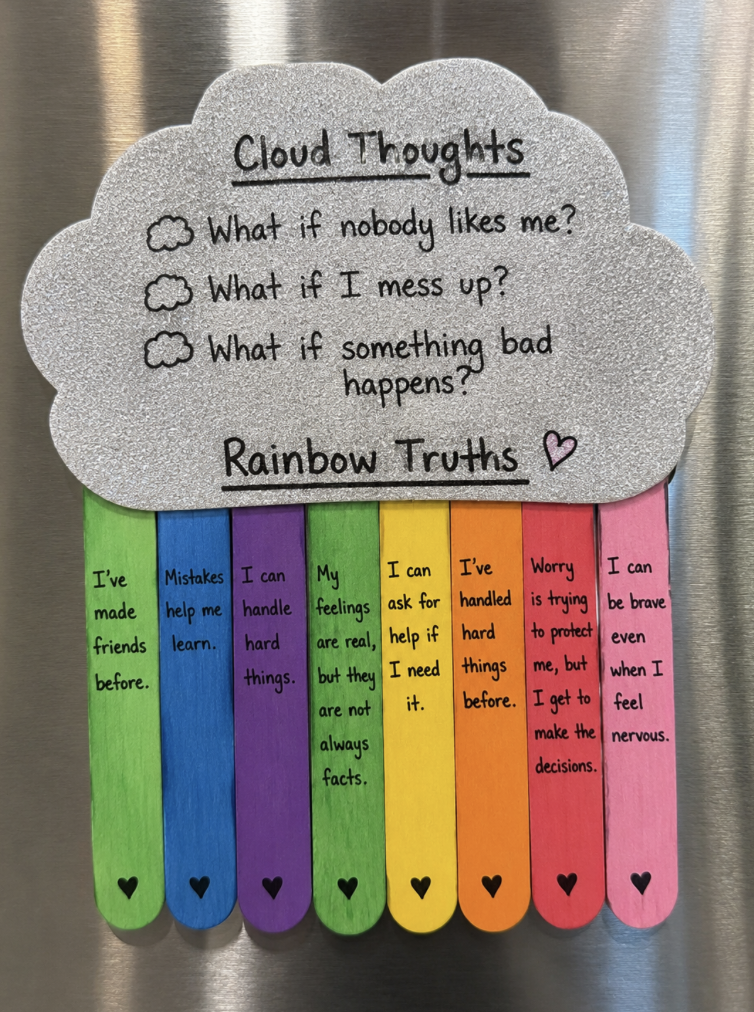
Use colored popsicle sticks or cut strips of paper in rainbow colors — red, orange, yellow, green, blue, purple, and pink. These are the Rainbow Truths.
For each worry in the cloud, work with your child to find a more balanced, realistic thought. Don't rush this step. Let them think. Ask questions (more on that below). The truth should feel true to them — not just a cheerful thing you're hoping they'll believe.
Here are some examples to guide you:
Cloud Thought:"What if nobody likes me?" Rainbow Truth:"I've made friends before."
Cloud Thought:"What if I mess up?" Rainbow Truth:"Mistakes help me learn."
Cloud Thought:"What if something bad happens?" Rainbow Truth:"I can handle challenges when they come."
Other Rainbow Truths that resonate with many children:
💚 My feelings are real, but they're not always facts.
💙 I can ask for help if I need it.
💜 I've handled hard things before.
🩷 Worry is trying to protect me, but I get to make the decisions.
🌈 I can be brave even when I feel nervous.
Write one truth on each rainbow strip, then arrange them below the cloud so it looks like a rainbow coming out of the clouds! Display it somewhere your child can see it — the refrigerator, their bedroom door, their desk.
Questions Parents Can Ask During the Activity
The conversation is as important as the craft. Here are some prompts to use as you work through the activity together — and to return to later when anxiety shows up:
During the Activity
"What is your worry cloud saying right now?" — Helps them name it.
"What would your rainbow say back?" — Invites them to find a response.
"What would you tell a friend who had this same worry?" — Children are often kinder to friends than to themselves.
"Has this worry been wrong before?" — Builds evidence against the thought.
When Anxiety Shows Up Later
"Can you find a rainbow truth for that thought?"
"Is that a cloud thought or a fact?"
"What do you know that's true, even when this worry shows up?"
These small prompts, over time, start to become automatic. Your child begins to ask them of themselves. That's the goal.
Benefits of Cloud Thoughts → Rainbow Truths
Among anxiety activities for kids, Cloud Thoughts → Rainbow Truths stands out because it builds a range of coping skills for anxiety that serve children well beyond childhood:
Emotional Regulation. Children learn to pause, notice, and respond to their feelings rather than being swept away by them.
Confidence Building. Finding their own Rainbow Truths teaches children that they have the capacity to help themselves — that their mind is not their enemy.
Self-Awareness. Naming worry thoughts is the first step toward not being ruled by them. Kids who can say "that's a cloud thought" have already created distance from it.
Resilience. Every time a child practices finding a balanced truth, they strengthen the neural pathways that make it easier to do it again next time.
Problem-Solving. Over time, children start to generalize this skill — noticing unhelpful thinking in new situations and asking themselves what else might be true.
These are not small things. These are life skills.
When Anxiety May Need Additional Support
Anxiety activities for kids like this one can be genuinely helpful — and they work best when the anxiety is in the mild-to-moderate range and a child has some capacity to engage with their thoughts.
But sometimes, anxiety is louder. Sometimes it takes hold in ways that a craft activity can't reach on its own. Here are signs that your child might benefit from working with a child therapist:
School avoidance — Frequent stomachaches on school days, resistance to going, or significant distress at drop-off
Frequent reassurance seeking — Needing repeated reassurance that everything is okay, with relief that only lasts briefly
Sleep difficulties — Trouble falling asleep, nightmares, or coming to your room every night due to worry
Physical symptoms — Headaches, stomachaches, or other physical complaints that seem connected to stress or worry
Panic or significant distress — Meltdowns, crying, freezing, or refusal in situations that feel overwhelming
Avoidance patterns — Pulling back from activities, friendships, or experiences they used to enjoy
If your child is experiencing several of these, it doesn't mean something is wrong with them. It means their nervous system needs more support than conversation alone can provide.
At Hanisch Counseling Services, we specialize in anxiety therapy for kids and teens in New Jersey. We use evidence-based approaches including Cognitive Behavioral Therapy (CBT) and EMDR therapy — two of the most well-researched treatments for childhood anxiety. EMDR (Eye Movement Desensitization and Reprocessing) is particularly effective when anxiety is rooted in specific experiences or when worry feels stuck in the body, not just the mind.
You don't have to wait until things are really bad to reach out. Early support makes a real difference.
The Goal Isn't Positive Thinking — It's Realistic Thinking
Before we wrap up, one more thing worth saying clearly:
The goal of Cloud Thoughts → Rainbow Truths — and of anxiety therapy for kids more broadly — is not to teach children that everything is fine and nothing bad ever happens.
Life is hard sometimes. Hard things do happen. Your child's worries come from a real place.
The goal is to help them see the whole picture — not just the worst-case scenario, but also the truth of who they are and what they're capable of. The goal is for them to be able to look at a cloud thought and say, "That might happen. And I could handle it."
That's not toxic positivity. That's courage. And it's something you can practice together, starting tonight.
Frequently Asked Questions About Anxiety in Children
Q: How do I know if my child has anxiety or is just going through a phase?
Some worry is completely normal in childhood — new situations, big transitions, and occasional fears are part of development. Anxiety becomes a concern when it is frequent, intense, difficult to calm, and begins to interfere with daily life (school, friendships, sleep, family activities). If worry is getting in the way consistently, it's worth talking to a professional.
Q: Should I avoid the things that make my child anxious?
Avoidance provides short-term relief but tends to make anxiety stronger over time. Gradually, gently helping your child approach the things they fear — with support — is more effective than avoiding them. A child therapist can help you figure out the right pace for your child.
Q: My child says they don't want to talk about their worries. What should I do?
Some children aren't ready to talk directly about anxiety — and that's okay. Activities like this one can be a lower-pressure way in, because the focus is on the craft, not a conversation. A therapist can also use play, art, and other modalities to help children who struggle to talk about their feelings.
Q: What's the difference between CBT and EMDR for child anxiety?
CBT (Cognitive Behavioral Therapy) focuses on identifying and changing unhelpful thought patterns and behaviors. It's highly effective for generalized anxiety, school anxiety, perfectionism, and social worry. EMDR (Eye Movement Desensitization and Reprocessing) works more directly with the nervous system and is especially helpful when anxiety is connected to specific frightening experiences or when worry feels physical and hard to "think your way out of." Many children benefit from a combination of both.
Q: At what age can children start anxiety therapy?
Children as young as 4 or 5 can benefit from therapy, though the approach looks very different from what adults experience. For younger children, therapy is often more play-based and sensory. By ages 6–8, most children can engage meaningfully with activities like Cloud Thoughts → Rainbow Truths, and by 10–12, they can participate in more structured CBT work. The right approach depends on the child, not just the age.
Looking for More Anxiety Activities for Kids?
If your child is struggling with worry, school anxiety, social fears, perfectionism, or emotional overwhelm, professional support can help. At Hanisch Counseling Services, we provide anxiety therapy for children and teens throughout New Jersey using evidence-based approaches such as CBT and EMDR. We work collaboratively with parents throughout the process, because you are one of the most powerful tools in your child's healing.
📍 Serving families across New Jersey 📞 Contact us today to schedule a consultation!
Together, we can help your child build confidence, resilience, and coping skills that last far beyond childhood!

Help Your Child Feel More Confident & Less Anxious—Starting Today
This step-by-step guide is filled with proven strategies I use in therapy sessions to help children manage anxiety, build confidence, and develop lasting coping skills.
What’s Inside:
✔️ Scripts to help you respond to your child’s worries (without making them worse!)
✔️ Printable activities & coping tools to use at home
✔️ Simple, effective strategies to help your child feel calmer & more in control
This eBook was designed for parents who feel stuck and don’t know where to start. These are the same tools I teach in therapy—now available for you to use at home.